
McDonnell Douglas F-15A Eagle
Some Hystory
Representing a logical progression from the F-4, the McDonnell
Douglas F-15 Eagle was the outcome of a USAF funding request in
1965 for a new air-superiority fighter (at just about the time
the US Navy's F-4 was first adopted by the USAF). First flown on
the 27 July 1972, the F-15A emerged as a single-seat
twin-turbofan aircraft featuring broad centre and rear fuselage,
fixed geometry swept wings of low aspect ratio, tall twin
vertical tail surfaces and all-moving horizontal tail surfaces
with saw-tooth extended leading edges. 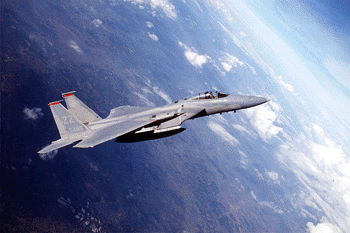 Pratt $ Whitney F100-PW-100 turbofans with external
compression inlets bestowed Mach 2.5 performance at high
altitude, in turn resulting in extensive use of titanium (more
than 20% of the airframe weight).Production of the F-15A
continued until 1979 with 385 built, including 19 delivered to
Israel.
Pratt $ Whitney F100-PW-100 turbofans with external
compression inlets bestowed Mach 2.5 performance at high
altitude, in turn resulting in extensive use of titanium (more
than 20% of the airframe weight).Production of the F-15A
continued until 1979 with 385 built, including 19 delivered to
Israel.
The principal variant thus far is the F-15C, whose first
production examples appeared in 1979 and had reached 481 before a
temporary production halt was called in November 1989; limited
production resumed in the first half of the 1990s. Export have
been made to Israel and Saudi Arabia.This version, which is now
in service with the USAF tactical fighter wings and fighter
interceptor squadrons in the USA (including Alaska), at
Kadena(Okinawa), and in Europe, features provision for a pair of
conformal fuel tanks (CFTs) which each contain 3228 Litres of
usable fuel and which are fitted 'flush' to the sides of the
inlet trunks, thus leaving all store hardpoints available for
ordnance(or further fuel tanks). Tangential store mountings have
been developed, allowing up to 12 further 454-kg (1000lb) stores
to be located at the lowershoulders of the CFTs, in all
representing an external store load of 10705kg. Avionics include
Hughes APG-63 ofr later APG-70 pulse Doppler radar, General
Electric automatic analog flight control system, IBM central
computer, Northtrop Enhanced ALQ-135(V) integral automatic
jammer, Magvavox EW warning subsystem and DCC stores management
system. Inbuilt armament comprises of a single 20-mm M61A1
six-barrel cannon with 940 rounds in the right-hand wing root,
and a normal missile firt is either four AIM-7 F/M Sparrow
medium-range AAMs and four AIM-9l/m Sidewinder short-range AAMs,
or eight AIM-120 AMRAAMS.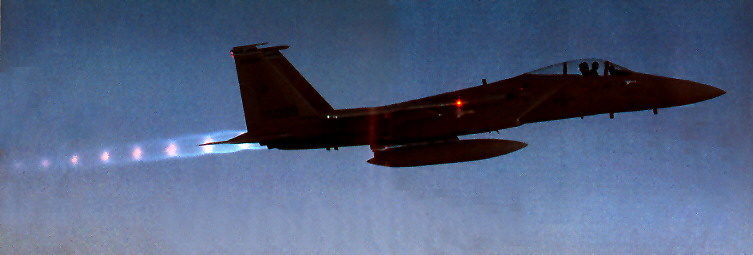
In service F-15Cs have replaced all F-15As in the regular wings, the redundant aircraft being introduced into the Air national Guard. The F-15C was selected for licence production by Japan, 14 US-built aircraft preceding the first of a planned 189 F-15J fighters manufactured by Mitsubishi.
The F-15 Eagle is an all-weather, extremely maneuverable, tactical fighter designed to gain and maintain air superiority in aerial combat.
The Eagle's air superiority is achieved through a mixture of unprecedented maneuverability and acceleration, range, weapons and avionics. It can penetrate enemy defense and outperform and outfight any current or projected enemy aircraft. The F-15 has electronic systems and weaponry to detect, acquire, track and attack enemy aircraft while operating in friendly or enemy-controlled airspace. Its weapons and flight control systems are designed so one person can safely and effectively perform air-to-air combat.
The F-15's superior maneuverability and acceleration are achieved through high engine thrust-to-weight ratio and low wing loading. Low wing-loading (the ratio of aircraft weight to its wing area) is a vital factor in maneuverability and, combined with the high thrust-to-weight ratio, enables the aircraft to turn tightly without losing airspeed.
A multimission avionics system sets the F-15 apart from other fighter aircraft. It includes a head-up display, advanced radar, inertial navigation system, flight instruments, UHF communications, tactical navigation system and instrument landing system. It also has an internally mounted, tactical electronic-warfare system, "identification friend or foe" system, electronic countermeasures set and a central digital computer.
Through an on-going multistage improvement program the F-15 is receiving extensive upgrade involving the installation or modification of new and existing avionics equipment to enhance the tactical capabilities of the F-15.
The head-up display projects on the windscreen all essential flight information gathered by the integrated avionics system. This display, visible in any light condition, provides the pilot information necessary to track and destroy an enemy aircraft without having to look down at cockpit instruments.
The F-15's versatile pulse-Doppler radar system can look up at high-flying targets and down at low-flying targets without being confused by ground clutter. It can detect and track aircraft and smalll high-speed targets at distances beyond visual range down to close range, and at altitudes down to tree-top level. The radar feeds target information into the central computer for effective weapons delivery. For close-in dog fights, the radar automatically acquires enemy aircraft, and this information is projected on the head-up display.
An inertial navigation system enables the Eagle to navigate anywhere in the world. It gives aircraft position at all times as well as pitch, roll, heading, acceleration and speed information.
The F-15's electronic warfare system provides both threat warning and automatic countermeasures against selected threats. The "identification friend or foe" system informs the pilot if an aircraft seen visually or on radar is friendly. It also informs U.S. or allied ground stations and other suitably equipped aircraft that the F-15 is a friendly aircraft.
A variety of air-to-air weaponry can be carried by the F-15. An automated weapon system enables the pilot to perform aerial combat safely and effectively, using the head-up display and the avionics and weapons controls located on the engine throttles or control stick. When the pilot changes from one weapon system to another, visual guidance for the required weapon automatically appears on the head-up display.
The Eagle can be armed with combinations of four different air-to-air weapons: AIM-7F/M Sparrow missiles or AIM-120 Advanced Medium Range Air-to-Air Missiles on its lower fuselage corners, AIM-9L/M Sidewinder or AIM-120 missiles on two pylons under the wings, and an internal 20mm Gatling gun (with 940 rounds of ammunition) in the right wing root.
Low-drag, conformal fuel tanks were especially developed for the F-15C and D models. Conformal fuel tanks can be attached to the sides of the engine air intake trunks under each wing and are designed to the same load factors and airspeed limits as the basic aircraft. Each conformal fuel tank contains about 114 cubic feet of usable space. These tanks reduce the need for in-flight refueling on global missions and increase time in the combat area. All external stations for munitions remain available with the tanks in use. AIM-7F/M Sparrow and AIM-120 missiles, moreover, can be attached to the corners of the conformal fuel tanks.
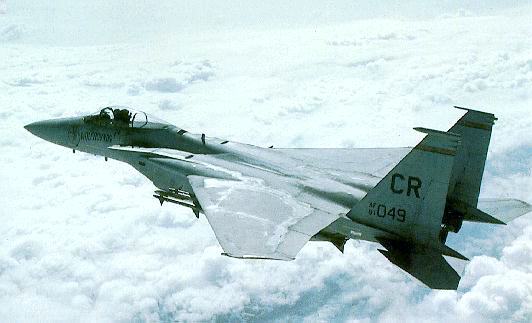
The first F-15A flight was made in July 1972, and the first flight of the two-seat F-15B (formerly TF-15A) trainer was made in July 1973. The first Eagle (F-15B) was delivered in November 1974 to the 58th Tactical Training Wing, Luke Air Force Base, Ariz., where pilot training was accomplished in both F-15A and B aircraft. In January 1976, the first Eagle destined for a combat squadron was delivered to the 1st Tactical Fighter Wing at Langley Air Force Base, Va.
Other units equipped with F-15s include the 36th Fighter Wing, Bitburg Air Base, Germany; 325th Fighter Wing at Tyndall Air Force Base, Fla.; 33d Fighter Wing, Eglin Air Force Base, Fla.; 32d Fighter Squadron, Soesterberg AB, Netherlands; and the 3d Fighter Wing, Elmendorf Air Force Base, Alaska. In January 1982, the 48th Fighter-Interceptor Squadron at Langley Air Force Base became the first Air Force air defense squadron to transition to the F-15.
The single-seat F-15C and two-seat F-15D models entered the Air Force inventory beginning in 1979. Kadena Air Base, Japan, received the first F-15C in September 1979. These new models have Production Eagle Package (PEP 2000) improvements, including 2,000 lb (900 kg) of additional internal fuel, provision for carrying exterior conformal fuel tanks and increased maximum takeoff weight of up to 68,000 lb (30,600 kg).
F-15C's, D's and E's were deployed to the Persian Gulf in 1991 in support of Operation Desert Storm where they proved their superior combat capability with a confirmed 26:0 kill ratio.
Specification : McDonnell Douglas F-15C Eagle
Origin : USA
Type : air-superiority fighter with secondary strike/attack role
Powerplant : two 10782Kg (23770lb) afterburning thrust Pratt & Whitney F100-P-220 turbofans
Performance : max speed more than Mach 2.5 or 1433 kt (2655km/h ; 1650 mph) at high altitude; service ceiling 60000ft; max unrefuelled range 5745 km with conformal fuel tanks.
Weights : empty 12973 kg; Max take-off 30844Kg.
Dimensions : span 13.05m ; length 19.43m ; height 5.63m ; wing area 56.48sqm.
Armament : air-to-air weaponry comprises one 20mm M61A1 Vulcan six-barrel cannon and provision for four AIM-9L/M Sidewinder and four AIM-7F/M Sparrow AAMs or eight AIM120 AMRAAMS; when configured for the attack role with five weapon stations(including two on CFTs) up to 10705kg (23600lb) of bombs, rockets and other air-to-surface weapons can be carried.
Crew : F-15A/C: 1; F-16B/D: 2
Unit Cost : $15 million
Constructor : McDonnel Douglas