
McDonnell Douglas F/A-18A/C Hornet
The McDonnell Douglas F/A-18 Hornet was designed to fulfill the distinct fighter and attack roles, and consequently is produced in a form easily adaptable to either of them through a change in mission computer software. The first role resulted from the increasing realization in the USA during the early 1970s that there existed the requirement for an aircraft which was inexpensive, straightforward to produce and light in weight as a replacement for the McDonnell Douglas F-4 Phantom II and to operate in combination with the more sophisticated, but heavier and more expensive Grumman F-14 and McDonnell Douglas F-15. The second role was derived from the need to replace the Vought A-7 Corsair II. For the US Navy and US Marine Corps, a mix of the F-14 and F/A-18 was determined, while the US Air Force adopted the combination of the F-15 and General Dynamics F-16 Fighting Falcon.
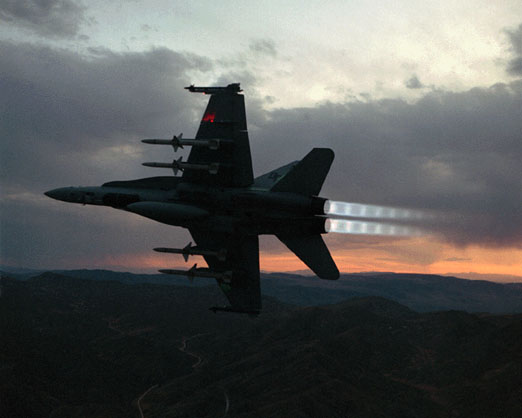
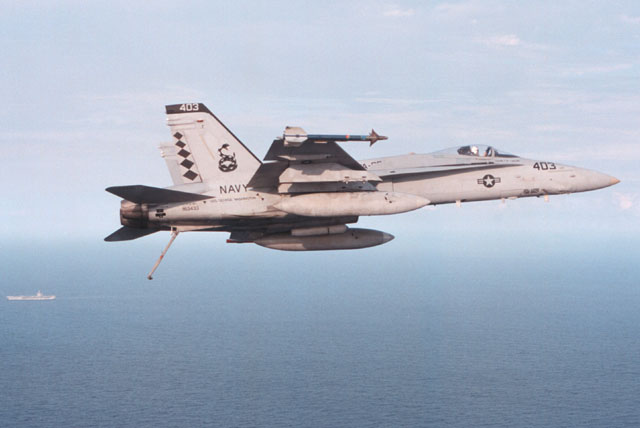
The Hornet was derived from the Northtrop YF-17. In May 1975 it was announced that the new aircraft would be built by McDonnell Douglas as prime contractor with Northtrop Corporation undertaking 30 per cent of airframe developement and 40 per cent airframe production work. In developing it from the YF-17 its wing area was increased, and it was given a wing-fold capability, a retractable inflight-refuelling probe, provisions for AIM-7 Sparrow medium range missiles and increased fuel capacity.
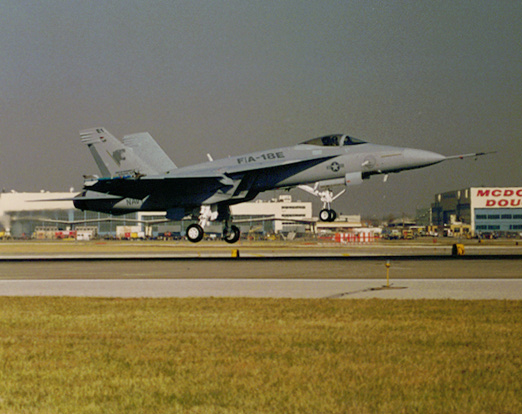
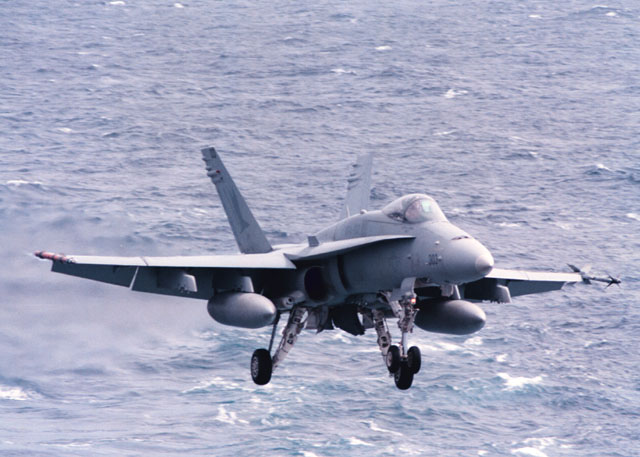
Full-scale production of the F/A-18A began on 22 January 1976 and the maiden flight took place on 19 November 1978.Although the type was originally to have been produced in separate F-18 and A-18 forms suiting it to two different roles, it was finalized in a single form and the process of conversion from one role to another is very simple and quick.In addition to those on order for the US Navy, delivery of 98 land based CF-18A aircraft to the Canadian Armed Forces began in 1982.
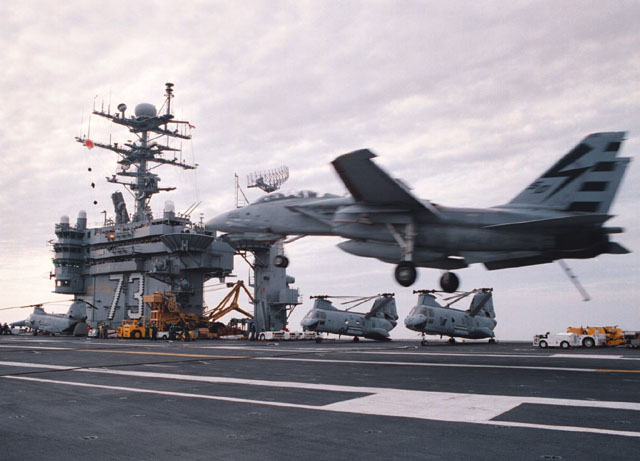

After delivery of 371 F/a-18s,production switched in 1987 to the improved F/A-18C with databus-linked small computers rather than one large computer, a more modern ejector seat, provision for reconnaissance equipment as well as the AIM-120A AMRAAM and AGM-65F Maverick air-to-surface missiles, and in current F/A-18C Night Attack aircraft the Hughes AAR-50 Thermal Imaging Navigation System. The F/A-18C has been bought by the US Navy and also by Finland, Kuwait and Switzerland.
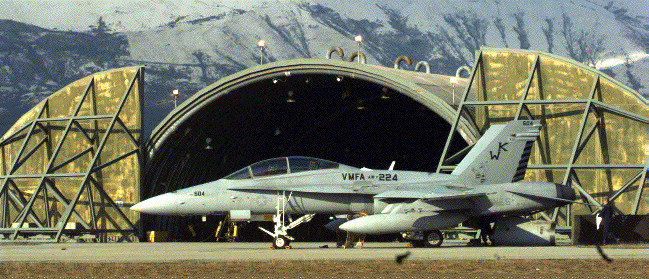
Specification:McDonnell Douglas F/A-18C Hornet
Origin: USA
Type: carriernorne fighter and attack craft.
Powerplant: two 7257-kg afterburning General Electric F404-GE-400 turbofans.
Performance: Max speed more than Mach 1.8 pr 1032kt sat 40000ft ,combat radius 740km in fighter escort role of 1065 km in the attack role.
Weights: empty 10455 kg; max take-off 25401 kg.
Dimensions:span 11.43m; length 17.07 m; height 4.66m; wing area 37.16 sqm
Armament: one 20-mm M61A1 Vulcan six-barrel rotary cannon with 570 rounds; up to 7711 kg of disposable stores, including AAMs, anti-ship missiles, free-fall or guided bombs, cluster bombs, dispenser weapons, napalm tanks, rocket launchers, drop tanks and ECM pods, carried on nine external hardpoints.